
Gorgy Time · Adder Authorised Dealer

One accurate time, building-wide

One reference time for the whole building — shift records, access logs and automation see the same second.

Similar facilities

Have we worked on a facility like yours?

The same system is not the same job in a factory, a hospital and a marina. Pick your facility type and we'll send you the scope of work we do for that type, along with a tailored quote.

  • Operator loading a part into a CNC machine in a production hall; a clock and a fire hose cabinet on the back wallFactory and production facility
  • Employee presenting a card to the reader at an industrial site's vehicle entrance; barrier, guard booth and a pole-mounted security cameraIndustrial zone and logistics centre
  • Nurse taking notes at the reception counter of a hospital ward; an LED digital hospital clock and a fire cabinet on the wallHospital and university
  • Technician measuring an open fire alarm panel in a hotel lobby, beside a technical manager holding a tabletShopping centre, hotel and retail
  • Bright airport terminal concourse with passengers and a red fire cabinet on a columnAirport and terminal
  • Marina attendant tying a mooring line on a pontoon; a shore power pedestal beside him, sailing boats behindMarina and port
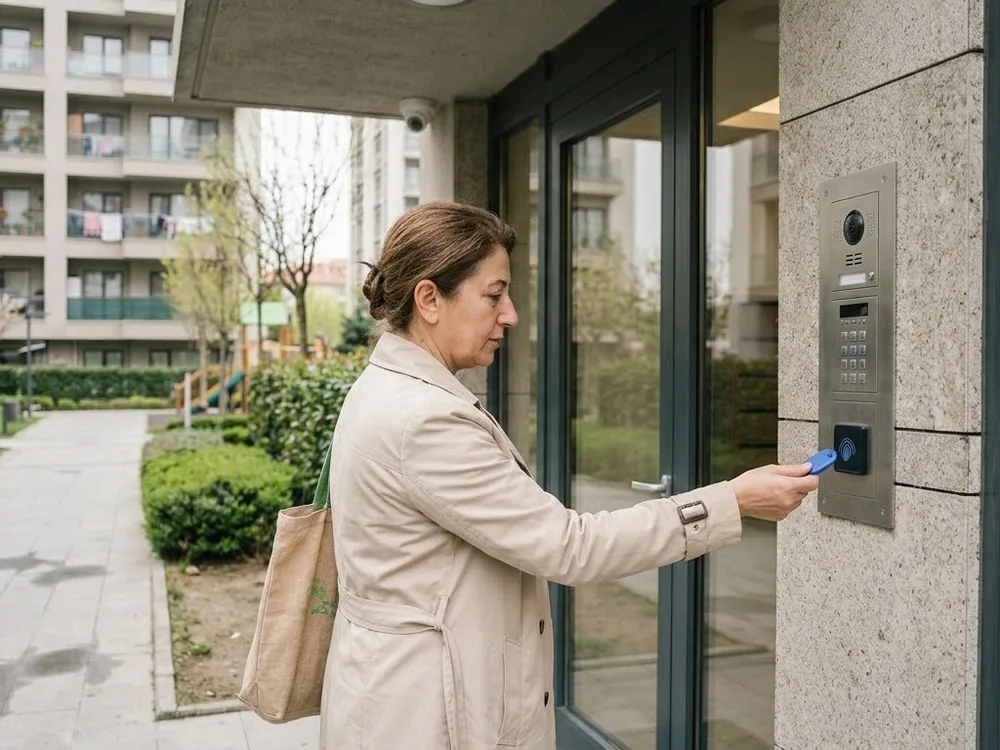
  • Resident holding a key fob to the card reader of a video intercom panel at a residential complex entrance; a security camera at the entranceResidential complex and housing development
  • Tell us your facility type and we'll describe similar work.Answered in writingTell us your facility type
Does this sound like you?

A time difference is an invisible problem — its cost is not

Situation 01

The shift log and the camera recording do not match

When the two systems' clocks drift a few minutes apart, investigating an incident hits a dead end.

Situation 02

There is a technician who sets every clock face by hand

The daylight-saving changeover means hours of manual work across the whole building.

Situation 03

Servers and PLCs are fed from different time sources

Log correlation and the audit trail lose their reliability.

Scope

Master clock, distribution and clock faces — as one line item

We install the whole chain, from the time source to the last clock face; it can also be applied retroactively to an existing building.
  • GPS/GNSS or NTP-referenced master clock
  • Wired, wireless and PoE clock face distribution, indoor and outdoor
  • Time synchronisation to servers, PLCs and access systems (NTP / IEEE 1588 PTP)
  • Commissioning, acceptance testing and periodic maintenance
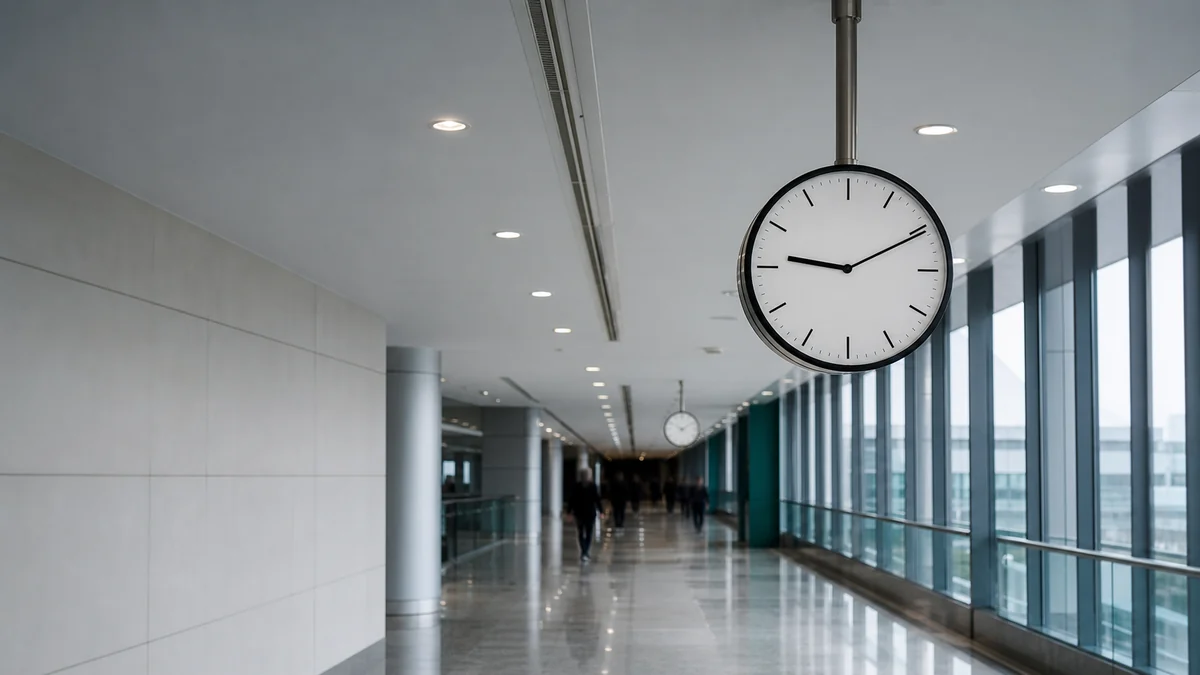
Analogue clocks hanging from the ceiling of a wide glass-walled concourse
Answered before you ask

The five questions we get most about master clock systems

Can this be installed retroactively in an existing building — does it require renovation?

It can, and often without pulling new cable. There are three distribution methods:

  • NTP / PoE clock faces — use your existing structured cabling. A single Cat cable carries both data and power; no separate outlet circuit is needed per clock face. This is the first option we look at in an existing building.
  • Wireless (radio-synchronised) clock faces — fed from a central transmitter, with no cable running to the clock face at all.
  • Classic impulse / AFNOR distribution — a single twisted-pair telephone cable carrying many clock faces on one line. This is the only method that requires new cable; it is generally chosen for new buildings or ones where the line is already in place.

So the answer depends not on the building but on your network infrastructure. During the site survey we first look at your existing cabling category and PoE capacity.

What determines cost — the number of clock faces, or the cabling?

In order:

  • Number and type of clock faces — indoor / outdoor (weather-resistant), single-face / double-face, analogue / digital.
  • Distribution method — PoE noticeably lowers installation cost; pulling new cable is the most expensive option.
  • Master clock class — a simple NTP server, or a nanosecond-class PTP (IEEE 1588) grandmaster.
  • Redundancy — dual master clock, dual antenna.
  • GNSS antenna and cable distance — if the run from the roof to the system room is long, a line amplifier or DC injector is needed; this item looks small but is a real cost in long buildings.

How long does installation take, and does production or the outpatient clinic stop?

The sequence of work is fixed: antenna mounting on the roof, commissioning the master clock in the system room, the distribution line, clock face mounting, and acceptance testing. Most of these steps are done while the facility keeps running.

Where a shutdown is needed, it is only for the power to the relevant panel or line; we schedule these between shifts, on a weekend, or during a planned stoppage. Because clock face mounting proceeds room by room, the whole facility never stops at any stage.

The installation time varies with the size of the project; we provide a schedule specific to your scope as an appendix to the quote.

What do you need from us — a floor plan, a single-line diagram, or network access?

For the quote, a floor plan and the points where clock faces are wanted are enough. Design also requires the following:

  • Rack space (typically 1U) and power for the master clock in the system room.
  • A mounting point with a clear view of the sky for the GNSS antenna on the roof, and a cable route.
  • If NTP will be used, UDP 123 opened by your network team — on corporate networks this port is very often closed by default, and it is the item that most often holds up the project.
  • An internal "approved time source" decision. ISO 27001:2022 A.8.17 already requires system clocks to be synchronised to an approved source; a master clock is the concrete step that satisfies this item.
  • Access to cable/power routing at the clock face points.

If the master clock fails, what do the clock faces do, and who responds?

When the master clock loses its GNSS reference, it does not stop: it keeps counting on its internal oscillator — this is called holdover. Accuracy degrades gradually depending on the oscillator class; more stable oscillator models are chosen for critical sites.

In critical facilities we build two layers of redundancy: dual master clock and dual antenna. On networks using PTP, the backup grandmaster takes over automatically.

How a clock face behaves on signal loss depends on the model (some stop at the last correct time, some keep running on their own quartz). We state the behaviour of the clock face you choose in writing in the quote — we do not leave you to guess.

On the response side: on sites under a maintenance agreement, the on-site response time after a fault is reported is defined in the contract.

Does your facility fall outside these five questions? Write to us, we will reply within 24 hours.

Send us your questionWe reply with a written quote.
Authorisations

Brands we are authorised for

We are an Official Siemens Dealer, and for Siemens fire detection, gas detection, emergency announcement, gas suppression, access control and security systems we are also an Authorised Maintenance and Service company. We are the Authorised Distributor for Turkey for Trimbox, and an Authorised Dealer for Rotarex, Gorgy Time and Adder.


SiemensTrimboxGorgy TimeRotarexAdder
Quote

Send us your floor plan, and we will work out the number of clock faces

A floor plan or a list of rooms is enough. We come back with a written quote covering clock face count, distribution type and a time source recommendation.